In the wild, survival depends on one essential skill: the ability to find food. For predators, hunting is not just about strength—it requires intelligence, patience, teamwork, and perfectly timed movements. Over millions of years of evolution, animals have developed unique hunting strategies that allow them to capture prey efficiently while conserving energy.
From stealthy ambush predators hiding in tall grass to coordinated hunters working together as a team, the animal kingdom is full of fascinating hunting techniques. These strategies show how animals adapt to their environment and use their natural abilities to survive.
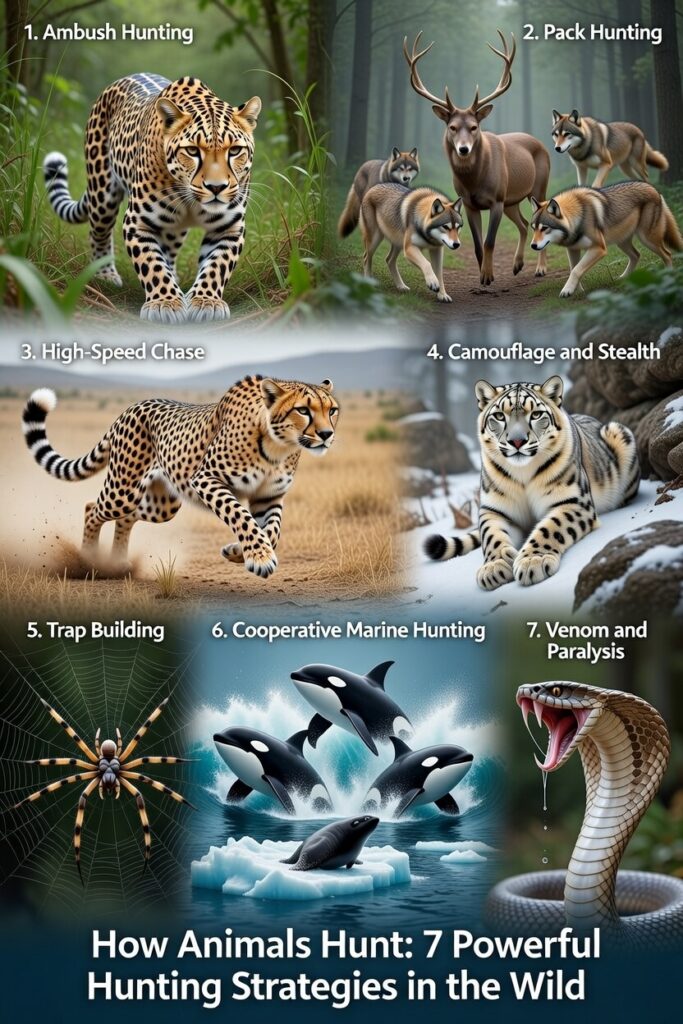
Here are seven powerful hunting strategies used by animals in the wild.
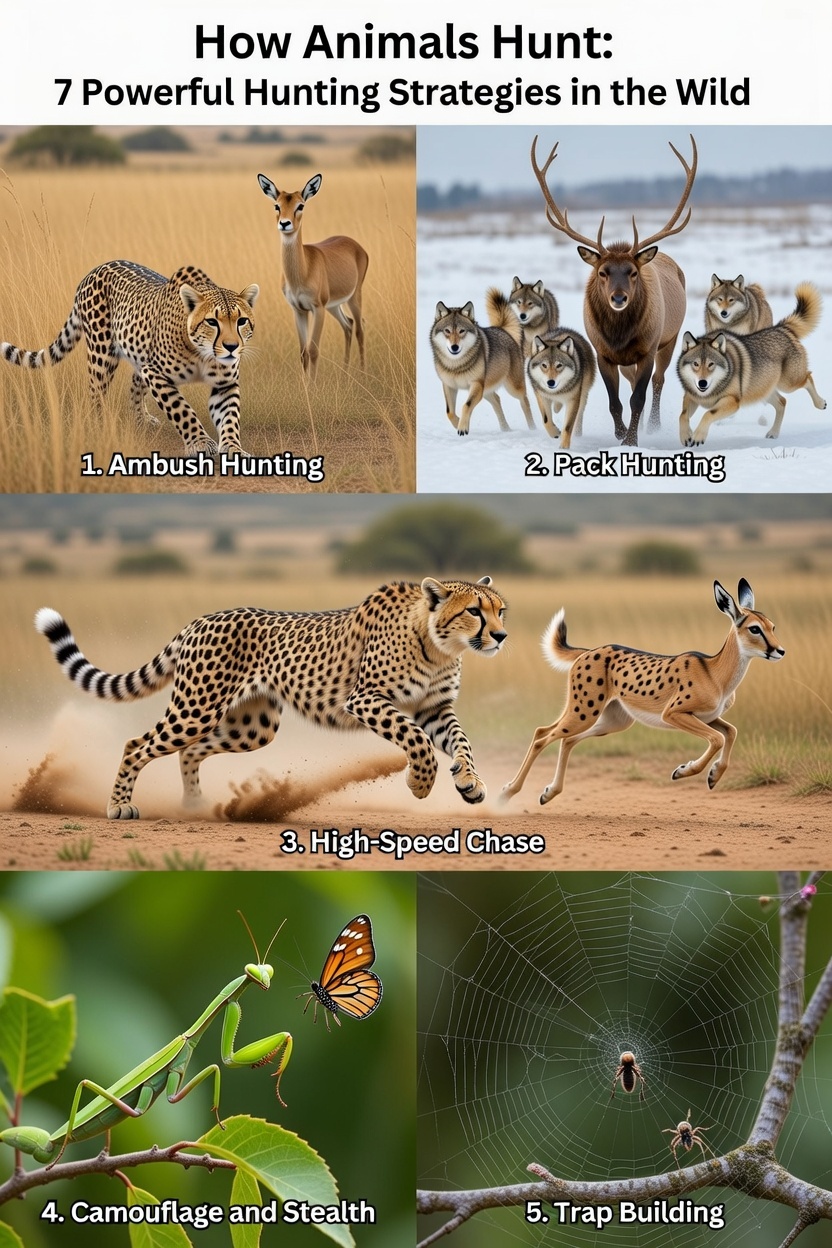
1. Ambush Hunting
Ambush hunting is one of the most effective strategies used by predators. Instead of chasing prey for long distances, ambush predators hide and wait for the perfect moment to attack.
Animals that use this strategy rely heavily on camouflage and patience. They stay motionless for long periods, blending into their surroundings until prey comes close enough.
Big cats such as lions, leopards, and tigers often use this method. They silently approach their prey and launch a sudden, explosive attack. Crocodiles are also masters of ambush hunting. They remain nearly invisible in water with only their eyes and nostrils above the surface before quickly grabbing animals that come to drink.
This technique allows predators to conserve energy and increase their chances of success.
2. Pack Hunting
Some predators hunt more effectively when they work together. Pack hunting involves a group of animals coordinating their movements to chase, surround, and capture prey.
This strategy requires strong communication and teamwork. Each member of the group may play a different role during the hunt.
Wolves are famous for their pack hunting abilities. They often target large animals such as deer or elk, which would be difficult for a single wolf to catch alone. By surrounding their prey and attacking from multiple directions, the pack increases its chances of success.
Other animals that use pack hunting include African wild dogs, hyenas, and sometimes dolphins.
3. High-Speed Chase
Some predators rely on speed rather than stealth or teamwork. These animals are built for rapid acceleration and short bursts of extreme speed.
The cheetah is the most famous example. It is the fastest land animal, capable of reaching speeds of over 100 kilometers per hour. During a hunt, a cheetah stalks its prey from a distance before launching a high-speed chase.
However, this strategy requires a lot of energy. If the chase lasts too long, the predator may overheat or become exhausted. That is why speed hunters must end the chase quickly or risk losing the opportunity.
4. Camouflage and Stealth
Many predators depend on their ability to blend into their surroundings. Camouflage allows them to approach prey without being detected.
Animals such as snow leopards, praying mantises, and certain species of fish use this method to remain hidden until the perfect moment. Their colors and patterns match their environment so well that prey often cannot see them at all.
Stealth hunters move slowly and carefully to avoid making noise. When they are close enough, they strike quickly and decisively.
This method is extremely effective in dense forests, coral reefs, and other environments where visibility is limited.
5. Trap Building
Some animals create traps to capture their prey instead of chasing them. This method is particularly common among insects and small predators.
Spiders are well-known trap builders. They spin intricate webs designed to catch flying insects. Once prey becomes trapped in the sticky threads, the spider quickly moves in to immobilize it.
Antlion larvae are another example. These small insects dig cone-shaped pits in the sand. When ants or other insects fall into the pit, the antlion grabs them from below.
Trap building allows predators to capture prey with minimal effort while saving energy.
6. Cooperative Marine Hunting
In the ocean, some animals use advanced cooperative hunting strategies that require precise coordination.
Certain species of dolphins work together to herd fish into tight groups known as “bait balls.” Once the fish are trapped, the dolphins take turns swimming through the group and feeding.
Orcas, also known as killer whales, demonstrate some of the most sophisticated hunting behaviors in the animal kingdom. In some regions, groups of orcas create waves to knock seals off ice floes. In other cases, they coordinate attacks to separate prey from a group.
These techniques show how intelligence and teamwork can make predators extremely efficient hunters.
7. Venom and Paralysis
Some predators rely on venom to immobilize or kill their prey quickly. Venom contains powerful toxins that affect the nervous system, muscles, or blood of the victim.
Snakes such as cobras and vipers inject venom through their fangs when they bite. The venom quickly weakens or paralyzes the prey, making it easier for the predator to consume.
Certain spiders, scorpions, and jellyfish also use venom to capture prey. This strategy allows smaller predators to hunt animals that might otherwise be difficult to overpower.
Venom is a highly specialized adaptation that has evolved in many different animal species.
Why Hunting Strategies Matter
Hunting strategies are essential for maintaining balance in ecosystems. Predators help control the populations of other animals, preventing overpopulation and protecting natural habitats.
Different hunting methods also reflect the unique abilities of each species. Speed, strength, intelligence, camouflage, and cooperation all play important roles in how animals survive in the wild.
Studying these strategies helps scientists understand animal behavior and evolution. It also reveals how predators and prey influence each other over time.
Conclusion
The wild is a place of constant challenge and adaptation. To survive, predators must be skilled hunters capable of using the right strategy at the right moment.
From stealthy ambush attacks to high-speed chases and complex team hunts, animals have developed incredible ways to capture their prey. These strategies demonstrate the remarkable intelligence and adaptability found throughout the animal kingdom.
As researchers continue to study wildlife behavior, we will likely discover even more fascinating hunting techniques used by animals around the world. Understanding these strategies not only helps us appreciate nature but also reminds us of the delicate balance that exists within every ecosystem. 🐅🌍